
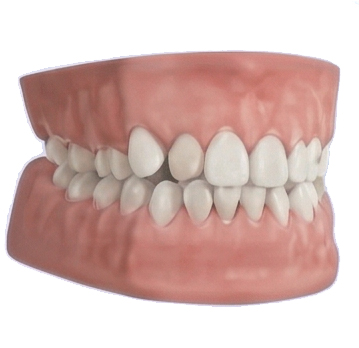
What Crooked Teeth Are
Crooked teeth are teeth that sit out of line with their neighbours. They may overlap, twist, tilt or stand forward of the arch.
Almost nobody has perfectly aligned teeth. The question is not whether yours are straight, but whether the way they sit is causing a problem.
This page explains why teeth grow crooked and what that leads to. If you already know you want them straightened, start at straighten my teeth instead.
Why Teeth Grow Crooked
Not enough room
This is the most common reason. The jaw is narrower than the teeth need, so they come through overlapping because there is nowhere else to go.
Jaw size and tooth size are both inherited, and they are inherited separately. A child can end up with one parent's jaw and the other parent's teeth.
Habits during childhood
Thumb sucking, prolonged dummy use, mouth breathing and an incorrect swallowing pattern all push on the developing jaw. Over years, that shapes how it grows.
Losing a tooth early
When a baby tooth comes out before it should, the teeth beside it drift into the gap. The adult tooth underneath then has nowhere straight to come through.
Drifting later in life
Teeth keep moving slowly throughout life. Front teeth crowding in your thirties or forties is common, and losing a back tooth speeds the whole process up.
What Crooked Teeth Cause
Appearance is what most people notice. The rest matters more.
- Plaque that will not come off. Where teeth overlap, a brush and floss cannot reach the surfaces between them
- Gum inflammation. Plaque sitting in a crowded spot leads to gum disease in that spot first
- Decay between teeth. The same surfaces you cannot clean are where decay starts
- Uneven wear. Teeth standing proud of the arch take more of the bite and wear faster
- Jaw strain. A bite that does not meet evenly makes the jaw work harder to find a comfortable position
- Chipping. A tooth sitting forward of its neighbours is the one that catches
These build slowly. That is why crooked teeth are easy to live with for years and then become a problem all at once.
When They Need Treating
Not every crooked tooth needs straightening. Your dentist looks at whether yours are causing harm, not simply whether they are out of line.
- Gums that bleed in one crowded area but nowhere else
- Repeated decay between the same two teeth
- Food packing in the same place every meal
- One tooth visibly wearing down faster than the rest
- Jaw ache or waking with a tight jaw
- Avoiding smiling in photographs
The last one counts. Wanting to feel comfortable with your own smile is a legitimate reason to treat, and we treat plenty of adults for exactly that.
Crooked Teeth in Children
Crowding in a child is often a symptom rather than the problem. Where a habit is shaping the jaw, straightening the teeth without addressing it means they drift back.
Bring your child for an assessment around age seven. Enough adult teeth are through by then to see how the bite is developing, and there is still growth to guide with early treatment or Myobrace.
How Crooked Teeth Are Straightened
- Traditional braces handle complex movement and bite correction
- Clear aligners suit mild to moderate crowding and are close to invisible
- Myobrace treats the habit behind the crowding in children
Which one applies depends on how far the teeth have to move and how old you are. Your dentist explains the realistic options after an examination and x-rays.
Straightening Crooked Teeth as an Adult
Plenty of our straightening patients are adults, and several are treating teeth that were straightened once before and drifted.
Teeth move at any age, because the bone around them keeps remodelling throughout life. Treatment can take a little longer than it would have at fifteen, and your gums need to be healthy before it starts, but age on its own is not a barrier.
Leaving Them Alone
Many people live with crooked teeth their whole lives without trouble, and that is a reasonable choice.
What is worth avoiding is leaving them alone while they cause damage you cannot see. Book an assessment so you know which situation you are in, then decide.
Related Reading
- Traditional Braces – fixed brackets and wires, day to day
- Clear Aligners – removable trays for milder crowding
- Myobrace – treating the cause in children
- Gum Disease – what crowded, uncleanable areas lead to
- Bruxism – grinding, and how it wears an uneven bite down