
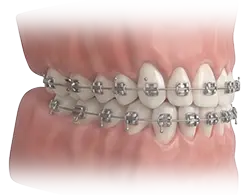
What Traditional Braces Are
Traditional braces are brackets fixed to each tooth and joined by a wire. Your dentist adjusts the wire, and the teeth follow it.
They are fixed in place, which is their main advantage. Treatment carries on whether you remember it or not, because there is nothing to take out and nothing to forget.
This page covers living with them day to day. For the treatment itself, see orthodontic braces in Johannesburg.
Metal or Ceramic
Metal brackets
The standard option. Strong, the smallest they have ever been, and the least expensive. They handle any movement your dentist asks of them.
Ceramic brackets
Tooth-coloured, so they are far less obvious from a conversational distance. They cost more, and they are slightly bulkier than metal.
Both move teeth the same way. The choice is about appearance and budget rather than what the treatment can achieve.
Who Braces Suit
- Anyone with significant crowding, rotation or large gaps
- People who need the bite corrected, not just the front teeth aligned
- Teenagers, where wearing a removable tray reliably is a lot to ask
- Adults whose case is beyond what clear aligners can achieve
- Anyone who would rather not think about their treatment daily
Healthy gums come first. Where gum disease is present, your dentist treats that before fitting anything, because braces make cleaning harder.
Getting Them Fitted
- Your dentist examines the bite, takes x-rays and impressions, and plans the movement.
- Your teeth are cleaned and dried, and each bracket is bonded on.
- The wire is threaded through and secured.
- You are shown how to clean around them before you leave.
Fitting takes an hour or two and needs no injection. Nothing is drilled, because the brackets bond to the enamel surface.
The First Two Weeks
This is the part worth preparing for. Your teeth feel tender for three to five days as they begin to move, and the brackets rub until your cheeks toughen up.
- Eat soft food for the first few days and let the tenderness settle
- Ordinary painkillers help, taken as you normally would
- Push orthodontic wax over any bracket that is rubbing
- Warm salt water rinses ease a sore spot
- Speech feels odd for a day or two, then stops being noticeable
Expect the same tenderness for a day after each adjustment, though far milder than the first time.
Eating With Braces
Most food is fine. What breaks a bracket is hard and sticky food, and a broken bracket means an extra appointment and a slower result.
- Avoid toffee, chewing gum, hard sweets and ice
- Go carefully with nuts, popcorn kernels and hard biltong
- Cut apples, carrots and corn off the cob rather than biting in
- Keep fizzy and sugary drinks down, since plaque already has more places to sit
Cleaning Around Brackets
This decides what your teeth look like when the braces come off. Plaque left around a bracket leaves a permanent white mark on the enamel underneath.
- Brush after every meal, angling the brush above and below each bracket
- Use an interdental brush to get under the wire
- Floss with a threader, or use a water flosser
- Keep your normal check-ups and cleanings running alongside
How Long They Stay On
Most cases run twelve to twenty-four months, with an adjustment every six to eight weeks. Simple front-tooth alignment finishes sooner, and bite correction takes longer.
The Day They Come Off
Removing braces takes one appointment and no anaesthetic. Each bracket is eased off, the bonding is polished away, and your teeth are cleaned properly for the first time in months.
Teeth often feel slippery and slightly strange afterwards, which passes within days. Some people notice mild sensitivity for a week.
A retainer is fitted at the same visit, either a thin wire bonded behind the front teeth or a removable one worn at night. Teeth drift back towards where they started for years afterwards, so the retainer is what makes the result permanent. Stopping it early is the most common reason people go through braces twice.
Book an assessment if you are considering braces. Your dentist will tell you honestly whether braces or aligners fit your case better, and roughly how long yours would take.
Related Reading
- Orthodontic Braces Johannesburg – the treatment in full
- Clear Aligners – the removable alternative
- Crooked Teeth – why teeth move out of line
- Early Interceptive Treatment – guiding growth before braces
- Gum Disease – treated before braces are fitted