
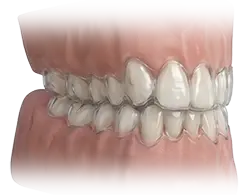
This page walks through the clear aligner process from the first appointment to the retainer at the end. For what aligners are and which systems we offer, see clear aligners in Johannesburg.
Step One: The Assessment
Your dentist examines your teeth and gums, takes x-rays, and checks how your bite meets.
This appointment decides whether aligners suit your case at all. Mild and moderate crowding responds well. Significant rotation, large gaps and bite correction usually need braces, and your dentist will say so rather than start treatment that cannot finish the job.
Any decay or gum disease is treated first. Aligners sit tight against the teeth, so nothing should be left underneath them.
Step Two: Scans and the Plan
A digital scan or impression records the exact position of every tooth. From that, your dentist plans the movement in sequence.
You are usually shown a simulation of the finished result before anything is made. This is the moment to say if the outcome is not what you had in mind, because changing the plan now costs nothing.
Your full set of trays is then manufactured, which takes a few weeks.
Step Three: Fitting
Your dentist checks the first tray fits properly and shows you how to take it in and out without straining it.
Small tooth-coloured attachments are often bonded to a few teeth at this visit. They give the tray something to grip, so it can tip and rotate a tooth rather than only pushing it. They come off at the end.
Step Four: Wearing Them
This is the part that decides whether treatment works.
- Wear each tray 20 to 22 hours a day
- Take them out to eat and to drink anything other than water
- Brush before putting them back in
- Change to the next tray on the schedule you are given, usually weekly or fortnightly
- Store them in their case, never a serviette
Aligners only work while they are in your mouth. A tray worn twelve hours a day does not move teeth half as fast, it simply does not move them properly at all.
Each new tray feels tight for a day or so. That tightness is the tray doing its job.
Step Five: Reviews
You are seen every six to ten weeks. Your dentist checks the teeth are tracking to plan, and hands over the next few trays.
Where a tooth has not kept up, the tray stops seating fully against it. Say so at the review rather than pushing on, because the fix is straightforward when caught early.
Step Six: Refinements
Most people need a second, shorter set of trays at the end. This is normal and not a sign anything went wrong.
Teeth do not always move exactly as planned, so a fresh scan is taken and a small number of refinement trays finish the detail. Ask at the assessment whether refinements are included in the quoted fee.
Step Seven: Retainers
The attachments are polished off and a retainer is fitted.
Teeth drift back towards where they started, for years afterwards. A retainer worn at night, or a thin wire bonded behind the front teeth, is what keeps the result you paid for.
Stopping the retainer is the single most common reason people go through aligner treatment twice.
When a Tray Will Not Seat
Every so often a new tray does not click fully into place, and there is a visible gap over one tooth. This is worth knowing about before it happens, because the instinct is to force it.
- Go back to the previous tray and wear it for a few more days
- Use the chewies you were given, biting gently along the arch
- Wear the tray more consistently, since a gap usually means hours were missed
- Phone us if it still does not seat after a few days
Carrying on through the rest of the set with a tray that does not fit is what turns a small delay into a full re-scan.
How Long the Whole Process Takes
- Minor front-tooth crowding, a few months
- Moderate crowding, roughly twelve to eighteen months
- Add a few weeks for manufacturing at the start
- Add a month or two for refinements at the end
Book an assessment to find out which bracket yours falls into. You leave that appointment knowing whether aligners can do what you want, roughly how long it would take, and what it costs.
Related Reading
- Clear Aligners Johannesburg – what they are and which systems we offer
- Traditional Braces – when the case needs fixed brackets
- Crooked Teeth – why teeth move out of line
- Gum Disease – treated before aligners begin
- Bruxism – grinding, and how it affects a finished result