
Why Wisdom Teeth Cause Trouble
Wisdom teeth are the last four molars to arrive, usually between seventeen and twenty-five. They come through when the jaw is already full.
Not every wisdom tooth needs removing. If yours came through straight and you can clean them, they are best left alone.
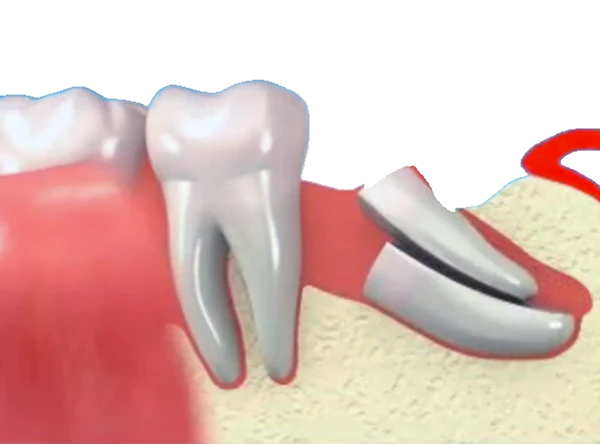
Problems start when there is not enough room. The tooth then comes through at an angle, or stays partly buried under the gum.
When Removal Is Recommended
- Repeated infection in the gum flap over the tooth.
- Decay in the wisdom tooth that cannot be filled properly.
- Decay forming in the healthy molar in front of it.
- Pain or pressure that keeps returning.
- A cyst forming around a buried tooth.
- The tooth biting into the cheek or the opposite gum.
The third one matters most. A tilted wisdom tooth traps food against the molar in front, and that molar is worth far more to you.
Impacted Wisdom Teeth
Impacted means the tooth cannot come through into its normal position. It may be tilted forward, sideways, or lying almost flat.
A partly erupted tooth is the hardest to keep clean. Bacteria collect under the gum flap, and the area swells and becomes painful.
That infection often settles with rinsing and antibiotics, then returns. Each episode is a sign the tooth will keep causing problems.
What Happens During the Procedure
- An x-ray shows the roots and how close they sit to the nerve.
- The area is numbed completely, so you feel pressure but not pain.
- A simple tooth is loosened and lifted out.
- A buried tooth needs a small gum opening, and is sometimes sectioned first.
- Stitches are placed if needed, and gauze is used to stop the bleeding.
Sectioning sounds worse than it is. Removing a tooth in pieces takes less bone away than lifting it out whole.
Most removals are done under local anaesthetic at the practice. Your dentist will tell you if your case is better suited to sedation.
Healing, Day by Day
Swelling peaks around day two or three, then improves. Bruising on the cheek is normal and fades over a week.
- First 24 hours. Bite on gauze, rest, and use a cold compress. Do not rinse.
- Day two. Start warm salt water rinses after meals.
- Days two to four. Swelling is at its worst, then eases.
- Week one. Soft food, and chew on the other side.
- Weeks two to four. The gum closes over the socket.
Do not smoke, and do not drink through a straw for a week. Both pull the clot out of the socket.
Dry Socket
A dry socket happens when the blood clot is lost before the gum heals. The bone underneath is then exposed.
The sign is pain that gets worse around day three instead of better. It often spreads towards the ear, and there is a bad taste.
It is treatable. Your dentist cleans the socket and places a dressing, and the relief is usually quick.
When to Phone the Practice
- Bleeding that has not stopped after several hours of pressure.
- Pain that increases from day three onwards.
- Swelling that spreads to the eye or the neck.
- Difficulty swallowing or opening your mouth.
- A fever.
Numbness of the lip or tongue that has not faded by the next day should also be reported, even though it usually settles.
Do All Four Have to Come Out
No. Each tooth is judged on its own position and its own history.
Some people have all four removed in one appointment, usually when all four are impacted. Others have one side done and keep the rest for years.
Doing one side at a time leaves you able to chew normally on the other. Doing all four at once means one recovery instead of two.
Planning the Time Off
Most people take two to three days for a straightforward removal. A buried tooth needs closer to a week before you feel normal.
Book it before a quiet stretch rather than before a busy one. Swelling is at its worst on day two or three, not on the day.
Avoid hard exercise for about a week. Raising your blood pressure can restart bleeding from the socket.
Related Reading
- Dental extraction, for other teeth
- Tooth decay
- Gum disease