
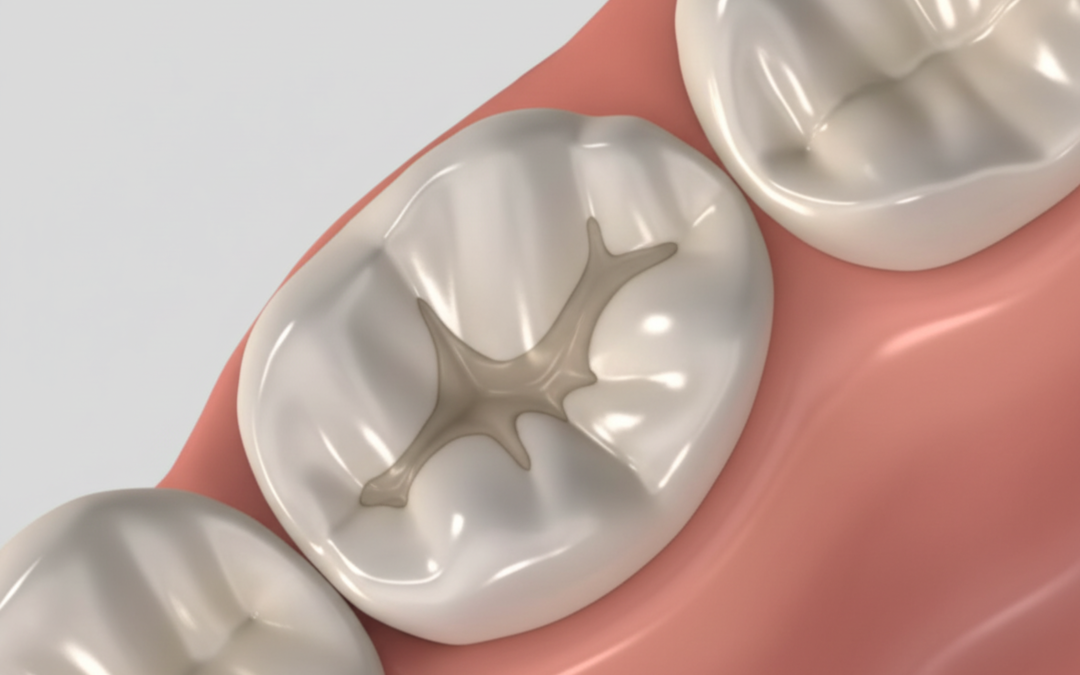
What Sealants Are
A sealant is a thin coating painted into the grooves on the biting surface of a back tooth. It sets hard and seals the groove closed.
Nothing is drilled and nothing is removed. No injection is needed, and the tooth is untouched underneath.
It is a preventive treatment, not a repair. The point is to stop decay starting rather than to fix it later.
Why Back Teeth Decay First
Look at a molar and you will see a pattern of pits and narrow grooves. They are there to grind food.
Those grooves are often narrower than a single toothbrush bristle. Food and bacteria drop in, and the brush passes over the top.
This is why most childhood cavities appear on back teeth, in children who brush reasonably well. It is the shape of the tooth, not the effort.
A sealant fills that groove, so the surface becomes smooth and cleanable.
Who Should Have Them
Children are the main group, and the timing follows the teeth rather than the birthday.
- Around age six. The first adult molars arrive at the back, behind the baby teeth.
- Around age twelve. The second adult molars come through.
- Baby molars. Sealed where a child is at high risk of decay.
- Adults. Suitable where the grooves are deep and still free of decay.
The first adult molars are easy to miss. They appear without any baby tooth falling out, so parents often do not realise they are there.
Sealing works best soon after a tooth comes through. Once decay has started, the tooth needs a filling instead.
What Happens at the Appointment
- The tooth is checked, to confirm there is no decay already in the groove.
- It is cleaned and dried completely.
- A gel is applied for a few seconds so the sealant grips, then rinsed off.
- The tooth is dried again, which is the step that decides how long it lasts.
- The sealant is flowed into the grooves and set with a light.
- Your dentist checks the bite feels normal.
It takes a few minutes per tooth and is completely painless. Children can eat straight afterwards.
Keeping the tooth dry is the hardest part with a young child. That is one reason it helps to do it early, before they are anxious.
How Long They Last
Sealants generally last several years, and many stay intact far longer. They wear gradually under chewing.
Your dentist checks them at every visit and tops up any that have chipped. Repairing one takes a couple of minutes.
A sealed tooth is not immune. Decay can still start between two teeth, which is why flossing still matters.
Do They Replace Brushing
No. Sealants protect one surface of one tooth, and that is all.
They do nothing for the sides of teeth, the gum line, or the front teeth. Brushing twice a day with fluoride toothpaste still does the heavy work.
Think of them as covering the one area a brush genuinely cannot reach.
Sealants and Fluoride Together
The two protect in different ways, so they are used together rather than as alternatives.
A sealant is a physical barrier over the grooves. Fluoride strengthens the whole tooth surface against acid.
Most children have both at the same visit. See polishing and fluoride for that part.
Is It Worth It
A sealant costs a fraction of a filling, and takes a fraction of the time. Nothing is drilled away.
Once a tooth is filled it enters a cycle. Fillings are replaced every so often, and each replacement is a little larger than the last.
Preventing the first filling is the most valuable thing you can do for a child's back teeth.
What They Are Made Of
Most sealants are a resin, similar to the material used for white fillings. Some are a glass ionomer, which releases fluoride slowly.
Your dentist chooses based on the tooth and the child. A partly erupted molar that is hard to keep dry often suits the fluoride-releasing type.
Sealants are set hard with a curing light before your child leaves the chair. Nothing is left soft in the mouth.